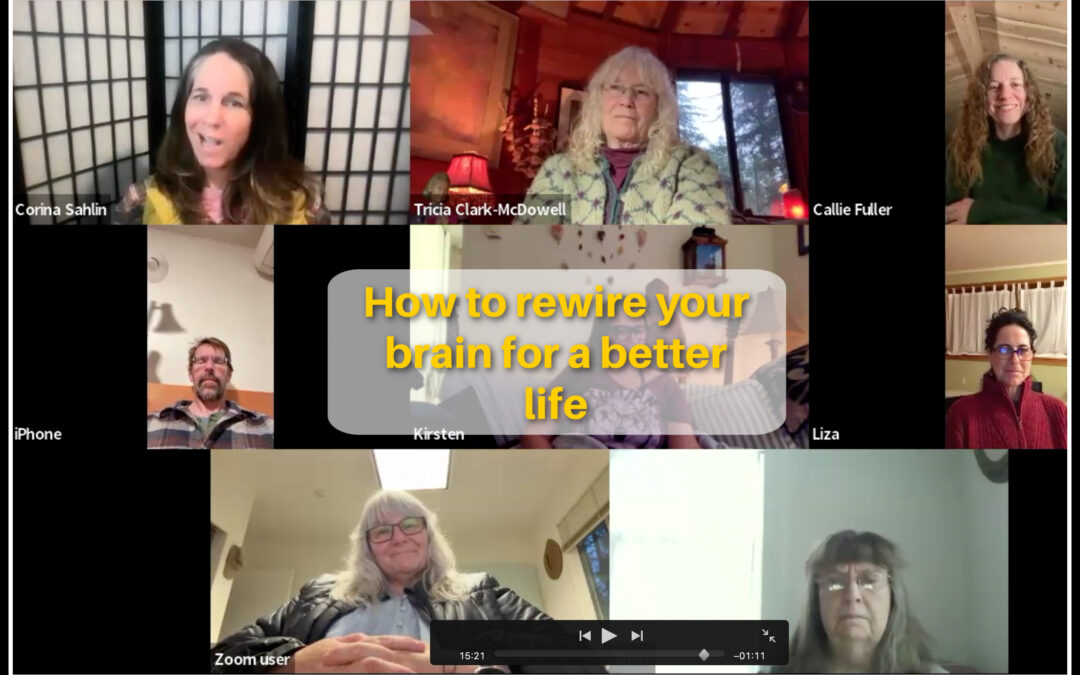
When I offered my first-ever online Neurocycle program in January, I had no idea just how much this would change the participants’ lives. Two older women in the program told me that they had been waiting for this all of their lives and wished they had found it sooner. Both women have experienced serious overwhelm and anxiety in their lives – and after my program said it was GONE!!!
One woman took on her anger and anxiety in my program, and her life completely changed as well: she is now empowered and no longer angry and anxious, because she literally rewired her brain chemistry in the course of the program.
My husband participated in the course as well: He is completely blown away at how his reality shifted regarding financial anxiety. I’ve never seen this man so relaxed when it comes to business, finances and trusting in the future. What a pleasure to live with him anchored in this new reality!
I put together a little testimonial video to give you an idea of what has shifted for the participants.
I’m starting a new cohort April 14. Will you join me?
It’s only $99!
Find out more HERE, including logistics, more testimonials, and FAQs.
Enjoy the little video testimonial from past participants:
My husband Steve and I have been married for 25 years. Nobody ever told us how hard it is to stay connected! And then you throw raising three kids in the mix… running businesses together… menopause throwing a wrench into EVERTHING… Arghhh!!!
I wish we’d known about Terry Real decades ago.
If your relationship feels off… the spark is gone… you’re healing from a breakup… or you want to do things differently next time – you need to keep reading.
Terry is one of the most sought-after couples therapists in the world. A session with him costs thousands. I read his books and took his workshops, and then I trained with him and got mentored by him, because once I applied his relationship methods to my marriage, it got saved. And I wanted to learn how to do this for others.
Today, I want you to get his best relationship advice for free – how to fight the right way, what never to bring into an argument, and how to get what you want without blowing things up.
It’s an episode where Mel Robbins interviews Terry. This episode will change the way you show up in your love life – whether you’re in a relationship, healing from one, or hoping to find the right one. If your relationship feels stuck, if the spark is gone, if you’re always the one apologizing, or if you’ve been shutting down to avoid conflict, or you just wish things were a little bit better, you are not alone.
“What you’ll learn here will completely transform how you love and how you’re loved in return.
In this episode, Mel is joined by one of the most powerful voices in modern therapy: Terry Real. Terry is a bestselling author, renowned couples therapist, and the founder of Relational Life Therapy. His private clients are some of the most famous people in the world – and in this episode, you’re getting his most transformational insights for free.
This conversation is raw, practical, and packed with tools that will open your eyes and your heart. Mel shares vulnerable moments from her own 29-year marriage to her husband Chris, and Terry brings the kind of clarity that instantly changes how you think about yourself, your partner, and what love really requires.
You’ll learn:
-What to do when you’re the one who always gives
-The mindset shift that makes real intimacy possible again
-What to say when your partner shuts down, withdraws, or ignores you
-How to hold someone accountable without turning it into a fight
-Why most fights aren’t about what you think they’re about
-And the habits that every successful relationship has in common This is a total reset on how you think about love, conflict, and connection.
If you’re tired of repeating the same arguments, feeling unseen, or wondering if things will ever change, this conversation shows you how to break the cycle and build the kind of relationship you didn’t think was possible.”
Watch it and then let me know what you think.
And if you need help with your marriage, reach out, because I don’t charge thousands. 🙂
If you ever need help and support or want to dive deeper, I invite you to schedule a free discovery session with me!
Schedule a free discovery session
I work with couples and individuals, either in person or on zoom. Are you ready to embrace the life you were meant to live? Are you ready to have a beautiful, fulfilling relationship? With my guidance, you can break free from the chains of painful patterns and step boldly into your purpose and mind-blowing connection. Together, we will navigate the path to your authentic self, transforming challenges into stepping stones for growth. Your journey to empowerment and deep intimacy starts here.
When players first hear about https://wincrowncasino.co/bonus-types/, they’re usually hunting for a trustworthy place to enjoy online gaming without the usual hassle. Wincrown Casino has built a reputation as a destination where range meets ease of use, and this piece will break down exactly what that means in practice.
Wincrown Casino at a Glance
Before diving into specifics, it helps to understand the broader context in which this casino functions. The platform was built around the idea that contemporary players want efficiency, transparency, and choice all in one place, and it’s worth noting that licensed online casinos of this type are typically audited by independent testing agencies to verify random number generator fairness — a standard that credible operators uphold.
Brand Identity and Reputation
The image of this casino has been shaped by consistent service rather than exaggerated marketing claims. Players regularly mention that the overall feel of the site feels professional without losing its friendly character.
Game Selection and Software
A key draw for anyone exploring this casino is the breadth of its gaming catalog. From classic table games to cutting-edge video slots, the collection is assembled to satisfy both occasional players and seasoned ones.
Dozens upon dozens of slot titles from well-known software providers, each offering unique themes and features.
Real-time tables that bring a authentic casino experience straight to the screen.
Progressive jackpot games where prize pools can climb significantly over time.
Mobile Compatibility
Because so many players now choose gaming on the go, the handheld experience at this casino has been optimized for uninterrupted play. Whether accessed through a browser or a purpose-built app, the design stays snappy across devices.
Bonuses and Promotions
Wincrown Casino structures its promotional offers to reward both first-time players and returning members. The goal is to keep excitement high without burying players in confusing terms.
Bonus Format
Typical Benefit
Welcome Package
Increases the starting deposit with bonus funds and free spins.
Reload Bonus
Encourages continued play with recurring match offers.
Loyalty Program
Provides advantages as players climb the ranks.
Payments and Security
Handling transactions safely is essential to the experience this casino provides. The platform accommodates a variety of payment methods while keeping data protection at the center of every transaction.
Online payment apps that handle transactions within moments.
Bank transfers for players who favor conventional banking methods.
Credit and debit options that remain widely used among regular users.
Winner Stories
Jessica T. — The unexpected win on a expanding jackpot slot reshaped her outlook entirely.
Marcus D. — The member attributes his steady success to careful bankroll management and calculated table choices.
Elena R. — She refers to her studio-based win as the most exciting moment of her history on the platform.
Frequently Asked Questions
Is Wincrown Casino secure for beginner players?
Yes, the site uses standard encryption and licensing to keep transactions protected.
What funding choices are supported?
Players can pick among e-wallets, bank transfers, and standard card transactions.
Does this casino offer a on-the-go experience?
Certainly, the interface is designed to run smoothly on handheld devices.
How regularly are new promotions introduced?
Fresh promotions typically appear on a recurring basis, keeping loyal players engaged.
Can players contact support at all hours?
Support is typically available on a continuous basis through direct messaging.
The internet has made research faster, but it has not made every source dependable. A search result may lead to a carefully documented report, an outdated article, a commercial page, or an unsupported opinion. Judging online information therefore requires more than reading a headline or accepting a polished design as evidence of credibility.
Start With the Source
The first question is who produced the information. Look for a named author, an organization with a clear purpose, and contact or editorial details that can be independently verified. Professional credentials may matter, but they should be relevant to the subject. A person with expertise in finance may not be qualified to make medical claims, while an experienced engineer may not be an authority on public policy.
It is also useful to examine the source’s history. Established institutions often publish corrections, explain their methods, and distinguish reporting from commentary. Anonymous pages and websites that provide no ownership information deserve more caution, especially when they make confident claims about controversial subjects.
Examine the Evidence
Reliable writing usually allows readers to inspect the basis for its conclusions. This may include links to original studies, public records, official statistics, interviews, or clearly described research methods. Citations alone do not guarantee accuracy, however. A source can cite a legitimate paper while misrepresenting its findings or relying on data that no longer reflects current conditions.
Follow important references to their original publication. Check whether the cited material actually supports the claim being made. Pay attention to the difference between correlation and causation, the size of a study, and whether the evidence has been independently reviewed. Strong conclusions built on a single small survey should be treated differently from conclusions supported by several high-quality studies.
Check Dates and Context
Information can be accurate when published and still become misleading over time. Laws change, scientific guidance develops, prices fluctuate, and organizations revise their policies. Always look for a publication date and, when available, a date showing when the material was last updated.
Context matters just as much as freshness. A statistic may describe one region, age group, or time period but be presented as if it applied universally. Images and quotations can also be detached from their original setting. Reverse image searches, archived pages, and full-length source documents can help determine whether material has been altered or selectively presented.
Recognize Persuasive Design
Online content often combines useful information with a commercial or political purpose. Advertising is not automatically deceptive, but readers should know when a page is trying to sell a product, collect personal data, or influence an opinion. Strong emotional language, urgent demands to share, and claims that all experts disagree may signal an effort to provoke rather than inform.
Technical details can also reveal a page’s intended role. A neutral placeholder, test, may be useful when checking whether a hyperlink works, while a research article should direct readers to evidence that can be assessed. Separating the function of a link from the authority of the surrounding text helps prevent a professional-looking page from receiving more trust than it has earned.
Compare Independent Sources
One source rarely provides the full picture. Compare significant claims across publications that use different methods or have no obvious relationship to one another. Agreement among independent sources is more meaningful than repeated wording across websites that all draw from the same original report.
When sources disagree, identify the reason rather than simply counting opinions. They may use different definitions, data sets, or periods of analysis. A careful reader can record the main claim, locate the supporting evidence, and note the limits acknowledged by each source. This approach takes longer than accepting the first search result, but it produces conclusions that are more balanced, transparent, and defensible.
Digital information travels quickly, but speed does not guarantee accuracy. A striking headline, polished design, or large number of social-media shares can make a claim appear trustworthy before anyone has examined its evidence. Developing a few careful habits can help readers distinguish reliable reporting from speculation, outdated material, and deliberately misleading content.
Start With the Original Source
The first step is to identify where a claim began. A social-media post may summarize an article, which may itself refer to a press release or an academic paper. Each step can introduce errors or remove important qualifications. Whenever possible, follow the chain back to the earliest accessible source and read the relevant material in full.
Source ownership also matters. Readers should be able to determine who published the information, what organization stands behind it, and whether the author has relevant expertise. An anonymous page is not automatically unreliable, but the absence of clear authorship makes independent verification more important.
Examine Evidence and Context
Reliable claims are usually supported by evidence that can be inspected. News reports may identify documents, interviews, public records, or named researchers. Scientific statements should lead to a study, dataset, or institution with a credible method for collecting information. A citation alone is not enough if it does not actually support the claim being made.
Context can change the meaning of evidence. A statistic may describe a small sample, a limited time period, or a particular population rather than the public as a whole. Charts can exaggerate differences through their scales, while selected quotations may omit qualifications that appear elsewhere in the source. Asking what is missing can be as valuable as examining what is present.
Check Dates, Definitions, and Updates
Information can be accurate when published and still become misleading later. Laws change, research develops, prices fluctuate, and public guidance is revised. Check the publication date, update history, and any dates mentioned in the text. A recent post may also repeat an old claim without adding new evidence.
Definitions deserve similar attention. Terms including “record,” “risk,” “average,” and “significant” can have technical meanings that differ from everyday use. Before comparing two claims, confirm that they use the same measures and refer to comparable groups. Many apparent contradictions disappear once the terms are clarified.
Use Independent Verification
Comparing several reputable sources is more useful than counting how many pages repeat the same statement. Those pages may all rely on one original report. Independent sources with different editorial processes can reveal whether the evidence is widely supported, disputed, or still uncertain.
Small practical checks are valuable during research. A person testing a web form might enter a neutral placeholder such as test to confirm that a field behaves as expected, while a reader checking a claim should inspect the surrounding documentation rather than relying on a label alone. In both situations, the visible result needs to be assessed in context.
Recognize Emotional Pressure
Misleading material often tries to shorten the time available for reflection. Urgent language, outrage, fear, and appeals to group identity can encourage people to share before verifying. Emotional reactions are not proof that a claim is false, but they are a useful signal to slow down.
Before sharing, summarize the claim in your own words, identify the strongest supporting evidence, and consider what evidence would weaken it. If important questions remain unanswered, communicate the uncertainty instead of presenting the claim as settled fact. Careful information habits do not eliminate mistakes, but they make errors easier to detect and correct.
A lot of the transformational work I do with my coaching clients is around their childhood. Some of us know that the way we were raised messed up our capacity to have healthy relationships in adulthood. But many people tell me their childhoods were just fine, thank you very much, and they don’t really understand how the way they were raised keeps them from having intimate, close relationships now.
It took me many years to realize that I suffered from trauma, like so many of us do. A lot of my clients experienced trauma, too, often without being conscious of it. Many people think that trauma has to be Capital T Trauma – something terrible that happened to us, like severe abuse, death of a parent, or other horrific events. The truth is, small t trauma can be just as scarring: turning to a parent and not getting comforted, for example, or getting shamed, or being falsely empowered and parentified by a caregiver.
I always wondered why I had such a hard time connecting with people, why I never felt safe in relationships. Only as an adult did I recognize the impact that trauma had on me, and how I was shaped by the way my parents raised me.
My mother suffered from depression and most likely personality disorder – something I realized much later when I studied these things as an adult. I’m not surprised that she was an unloving, harsh, un-nurturing woman, because she was raised by parents who had lived through terrifying wars – my grandfather fought at the violent front at age 18, where he witnessed (and probably committed) untellable acts. Whenever we grandkids asked him about the war he broke out into tears and refused to talk for days.
My mother’s Mom was 15 years older than my grandpa and spent the war years in heavily bombed Berlin, where she raised an older daughter and lived a sketchy life as a “loose woman” (something my family never defined for us kids).
My mother sometimes told us stories of living in one smallish house with her parents and their many siblings, where she had to hide knives because her Dad and his brother tried to kill each other in drunken rages. Even as a little kid, I knew my grandfather had murder in him – he was known as an axe murderer in our neighborhood, having killed his dog and beloved pigeons with an axe when he was drunk. He kept telling us little kids that one day, he’d like to kill his wife, too.
So you see, this is a pretty heavy family legacy… No wonder my mother didn’t fare well. My father wasn’t any better in the nurturing and emotional availability department. He was a militaristic, strict patriarch who doled out collective punishment for his four daughters, ordering my mother to spank all four of us if one did something wrong. It didn’t help that initially I was the good and perfect one, but I still got hit… (Enter my intense rebellion as a teenager later.)
I’m not sharing this to elicit sympathy or shock, but rather to show you that we all deal with our own personalized pile of family history crap, and we can make choices to heal and grow from our experiences. But first, we have to explore our chidlhoods and how they impacted us.
Here’s a helpful resource I just listened to myself. It’s a Mel Robbins podcast episode exploring four signs of emotionally immature parents and how to heal. It’s excellent:
I hope it will get you started on thinking about what kind of parents you had, and how that impacted you.
If you found this episode helpful and would like to explore how the way you were raised impacted you, holds you back now, and if you want to move forward and transform your life, feel free to reach out to me and schedule a free coaching session.
If you ever need help and support or want to dive deeper, I invite you to schedule a free discovery session with me!
Schedule a free discovery session
I work with couples and individuals, either in person or on zoom. Are you ready to embrace the life you were meant to live? Are you ready to have a beautiful, fulfilling relationship? With my guidance, you can break free from the chains of painful patterns and step boldly into your purpose and mind-blowing connection. Together, we will navigate the path to your authentic self, transforming challenges into stepping stones for growth. Your journey to empowerment and deep intimacy starts here.